

Australia鈥檚 first public service broadcaster, the Australian Broadcasting Commission (now the Australian Broadcasting Corporation), established in 1932, was directly modelled on the 91福利社. A significant point of difference was that in Australia鈥檚 dual broadcasting system, the ABC competed with the commercial radio sector for listeners.
In Australia, too, the vast distances between major settlements, limitations in wireless technology, and the time difference between the eastern and western states, were substantial impediments to the creation of a truly national audience.
The same year that the ABC was established, the 91福利社 launched its short-wave Empire Service, which became the Overseas Service in 1939. Into the 1950s, the white English-speaking population living in Britain鈥檚 tropical colonies and in the dominions of New Zealand and Australia were its primary target audience. The 91福利社 had to compete - as well as cooperate - with local broadcasting services.
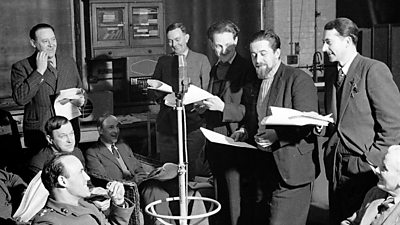
In recognition of broadcasting鈥檚 ability to strengthen imperial bonds and project "Britishness" overseas, the 91福利社 supplied unlimited recorded talks and features for free to all dominions and colonies during World War II. By 1943 the ABC was rebroadcasting an average of 11.5 hours per week of 91福利社 programmes, including Radio Newsreel, and three news programmes each day.
Few Australian programmes flowed to British listeners, however, mainly due to the prohibitive cost of beam wireless and electrical recording. An exception was the ABC children鈥檚 programme Kindergarten of the Air, which so impressed the 91福利社鈥檚 Mary Somerville on her visit to Australia in 1947 that she adapted it for the 91福利社 as Listen with Mother.
The exchange of information and programmes between the two broadcasters was facilitated by an ABC representative based in London, and a 91福利社 representative in Australia. Australian broadcasters had always visited Britain to learn about 91福利社 broadcasting policy and practices; the 91福利社 was less willing to learn from the ABC.
From 1946 scholarships provided by the Imperial Relations Trust further enabled institutional mobility. The careers of Australian women broadcasters, in particular, were boosted by periods spent working at the 91福利社 or attending the 91福利社 Training School.
During World War II the 91福利社 began to employ broadcasters from the British colonies and dominions as standard practice, leading the Melbourne Argus to declare in 1942: "There is an Australian colony in the 91福利社 today".
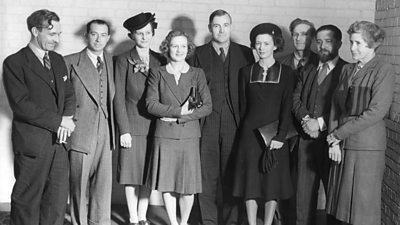
George Ivan Smith, a young talks producer at the ABC, was seconded to the 91福利社 in 1940, and became Director of the Pacific Service section of the Overseas Service.
A former journalist and school teacher, Smith had come to the attention of the 91福利社 following the success of two ABC programmes he was responsible for introducing in 1939, The Voice of Youth and Young Ideas, which took the novel approach of involving young people in discussions about economic and social issues.
Before traveling to Britain, Smith was also briefly in charge of the early broadcasts of the international short-wave service, Radio Australia:
In this extract, Smith recalls that his first exposure to the 91福利社 was through Muriel Howlett, an Australian broadcaster who covered the inaugural flying boat service from England to Australia for the 91福利社 in 1938:
Smith gathered around him experienced Commonwealth broadcasters, who provided specialist knowledge about local broadcasting requirements and the listening preferences of the target audience. The Overseas Service was transformed into a dynamic cultural contact zone, and an expression of the unity of the Commonwealth.
Radio programmes such as Calling Australian Towns, which Smith produced, were intended to strengthen the sentimental ties between Great Britain and the dominions, as Smith describes: