Strengthening newsrooms in Solomon Islands
We are working with journalists in Solomon Islands to help them keep up with a rapidly shifting information landscape
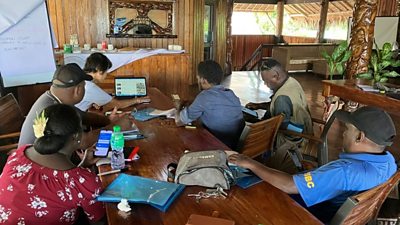
The way audiences in Solomon Islands, and the wider Pacific region, get their news is changing fast. Traditional media is under economic strain. Print and radio are losing ground to social media 鈥� where unverified claims spread quickly and often as easily as accurate reporting.
For public interest media professionals, this means keeping up with a rapidly shifting information landscape while protecting audience trust. Newsrooms and journalists in the provinces face an added challenge of missing out on training and skill-building opportunities that are frequently concentrated in the capital.
91福利社 Media Action is working with journalists and media practitioners across Solomon Islands to help them keep pace: training reporters in fact-checking and verification, creative use of digital tools and social media, and innovative storytelling and production.
"One of the biggest takeaways was the importance of putting our audiences at the centre of our journalism. The training introduced me to new ways of creating stories that are relevant, engaging, accurate, and responsive to the needs of our communities. I鈥檓 looking forward to sharing what I鈥檝e learned with my colleagues and putting these approaches into practice in Solomon Islands."
Countering misinformation and building audience trust
In Honiara, we conducted a fact-checking workshop in May 2026 - covering verification methods, image and video authentication, open-source intelligence (OSINT) tools, deepfakes, and GenAI. Journalists from the country's major newsrooms learned to trace where a claim began, check whether a photo or video is genuine, and spot deepfakes and AI-generated content. The course was developed by 91福利社 Verify OSINT editor Flora Carmichael and adapted for Solomon Islands by two senior local editors, who then led it themselves.
Misinformation also moves through communities, not just newsrooms. This means building trust in local journalism depends equally on building people's media literacy. In Buala, Isabel Province, we brought together 17 local government heads, civil society representatives and community leaders for our first digital media literacy workshop, held in March 2026. Participants learned to recognise and counter online disinformation, and to build trust between their communities and the press. The province's Deputy Premier, Tony Vahia, described strong digital literacy among community leaders as an essential social defence against rumours that risk undermining provincial harmony.

Meeting audiences where they are
Our audience insights research indicates a widespread drop in traditional print and radio consumption in favor of smartphone-driven news. To address this shift in how audiences consume public interest information, journalists need to adapt to new, digital platforms.
During the Eighth Pacific Media Summit in Savusavu, Fiji, in September 2026, we brought together 18 journalists and media leaders from six Pacific countries, including reporters from SIBC and Tavuli News, for an innovative digital storytelling workshop. Participants learned how to optimise content for digital screens and use social media apps in creative ways, while preserving editorial standards against unverified online content.
"These sessions were vital for modern newsrooms, highlighting the clear benefit of learning new approaches to audience engagement and the importance of producing journalism that is relevant, inclusive, and impactful."
This workshop built on our earlier training in Solomon Islands in June 2025, conducted in Honiara in collaboration with the Media Association of Solomon Islands (MASI), for 12 journalists and content creators. It covered content planning, audience growth, platform algorithms, analytics, and community management on Facebook, TikTok and YouTube. Participants also explored ethical ways to earn from their content - a critical skill as traditional broadcasting and print face economic pressure.
"This partnership with 91福利社 Media Action is a big win for the Solomon Islands media community. It helps strengthen not just our skills, but also media freedom and digital innovation in the Pacific."

Reaching journalists beyond the capital
A lot of our work focuses on reaching journalists who have limited access to skill-building opportunities. In August 2026, we brought provincial and outer-island reporters together for a five-day refresher training. Many had first been trained by 91福利社 Media Action and MASI ahead of the 2024 national vote. This time the focus was on adapting reporting workflows to a fast-moving digital ecosystem, with fact-checking and editorial independence at the centre.
"This workshop has been a massive help to me as a provincial freelancer. It has guided us on how to handle local news, conduct investigative reporting, ensure our information is balanced and accurate, and improve our visual storytelling."
Earlier, in September 2025, a week-long radio programming workshop in Gizo, Western Province, helped Radio Lagoon, a station that mostly relayed content from the capital, begin producing and broadcasting its own local programmes. Uluta Gina of the Solomon Star said what many outside Honiara feel: "We also want such trainings to come to us." The training was part of our ongoing commitment to supporting Solomon media through the Media Strengthening Project.

Supporting creative storytelling for social change
Culturally resonant content can help unpack complex socioeconomic issues such as climate resilience, civic rights, and social inclusion. In October 2025, radio programmers and producers from across the Pacific, including SIBC, spent a week in Suva, Fiji, learning radio drama production from 91福利社 Senior Trainer Ujjwal Maitra. The training guided participants through deep-dive modules in scriptwriting, character development, and narrative sound design. Participants learned how to develop engaging dramas addressing socially relevant issues in formats that appeal directly to rural and provincial families.
Earlier, in March 2025, in collaboration with the British High Commission, we provided professional production equipment to Dreamcast Theatre in Honiara. The group began as a grassroots drama company formed in response to the country's civil unrest, and it has grown into a cultural hub for peace, youth engagement and social cohesion. With a new mobile cast system, an intercom system, and studio audio and lighting, its teams can now produce multimedia packages, live-stream public events, and create educational dramas on local issues.

Strengthening democracy by amplifying local voices
The 2024 joint elections were a historic moment for Solomon Islands, and a chance for local media to put citizens at the centre of the coverage. In March 2024, we worked with MASI to bring 35 editors, provincial reporters, and newcomers together in Honiara for two weeks of election coverage training. In June 2024, specialist trainers ran a mobile journalism course that taught reporters to shoot, edit and package news using only a smartphone. They practised framing, shot sizes, camera angles and filming without a tripod, along with live-streaming and mobile-shot interviews that keep community concerns at the centre of coverage. The British High Commissioner, Thomas Coward, praised the vital, impartial role local journalists played in delivering transparent election coverage under immense pressure.
Ahead of the general elections, we also supported the launch of Voice Blo Iu (Voice of the People), the country's first audience-led debate programme, where rural youth, women, and community leaders ask questions and voice concerns directly to election candidates on issues that matter most to them.

Facilitating peer learning
Recognising the importance of peer learning, 91福利社 Media Action facilitated a one-week attachment for producers from SIBC at the National Broadcasting Corporation (NBC) of Papua New Guinea. The attachment provided producers with a new perspective on how an integrated newsroom operates and demonstrated how effective planning and teamwork contribute to successful daily news production.
"It gave me a better understanding of how a national public broadcaster operates and provided practical ideas that can be applied at SIBC. I look forward to working with my manager and colleagues to apply some of these ideas and improve our work in the Programs Department."
The Media Strengthening in Solomon Islands project is funded by the UK Foreign, Commonwealth and Development Office. Read more about the project.
Read more about our work in Solomon Islands
Read more about our work in the Pacific
Search by Tag:
- Tagged with Solomon Islands Solomon Islands
- Tagged with Pacific Islands Pacific Islands
- Tagged with Media development Media development