Television returns
Whilst the 91福利社 was recovering from the aftermath of war, plans were already afoot to re-launch its television service - the first in post-war Europe.

The Second World War had been perhaps 91福利社 radio’s finest hour. The corporation had helped to bind the nation together through news and entertainment, while also broadcasting information and hope into occupied Europe. But almost as soon as the war was over, preparations were being made for the return of the service which would eventually usurp radio in the audience’s affections – television.
During the war
The television service had been closed down in 1939 for several reasons. There had been fears the broadcasts could be used as homing signals to bomb London, and in the event the transmitter was employed as a countermeasure against a German navigation system.
Of the 300 or so television staff, the technical personnel would be needed for the war effort, on projects such as radar, and many others were seconded to various wartime broadcasting services.
Some thoughts had still turned to television, though. Particularly towards the end of the war, when owners of sets had begun writing to the 91福利社 to ask when transmissions would resume. Even John Logie Baird, the great pioneer of the invention of television, had written to the 91福利社 in October 1945 to enquire about its revival now the conflict was over.
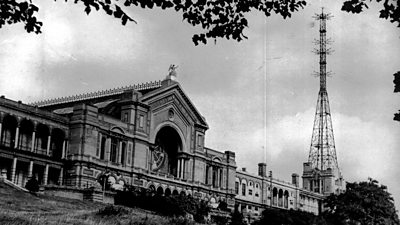
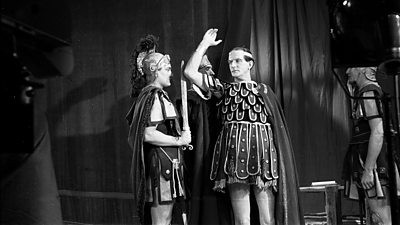
During the war there had been occasional closed-circuit experiments at the Alexandra Palace studios in North London, which had been home to the 91福利社鈥檚 1930s television service. Most prominently, a demonstration 鈥渙f a television programme of the 1939 standard鈥� was given in February 1945 for delegates to the Commonwealth Conference on Broadcasting. This featured the performance of an excerpt from Shakespeare鈥檚 Julius Caesar, and pre-war TV announcer interviewing actress Phyllis Calvert and Canadian Broadcasting Corporation chair Howard B. Chase.
鈥淒o you remember me?鈥�
It was Bligh, as the only returning announcer from the 1930s service, who was chosen to re-open television on Friday June 7 1946. At just after three o鈥檆lock that afternoon, following half an hour of tuning signals and then a film shot of the Alexandra Palace mast accompanied by a recorded drumroll and fanfare, for the first time in nearly seven years live television was broadcast by the 91福利社.
The initial live shot was from a camera cabled-up on the terrace outside the Palace. It showed a car drawing up from which Bligh then emerged, walked up to the camera, and said:
鈥淕ood afternoon everybody. How are you? Do you remember me, Jasmine Bligh?鈥�
Right from this initial query, there was a very definite and deliberate sense of wanting to link what was happening now to what had happened in those years before the war. This was explicitly laid out by Maurice Gorham, the new Head of the Television Service, in a memo written as plans for the re-opening programme were being made in April 1946.
鈥淭he rather pronounced note of reminiscence is I think justified both on policy grounds (we are resuming a service when other countries are starting theirs) and because it seems certain that the great majority of sets in use at this time will be pre-war sets and on this occasion pre-war viewers will also be in the majority.鈥�
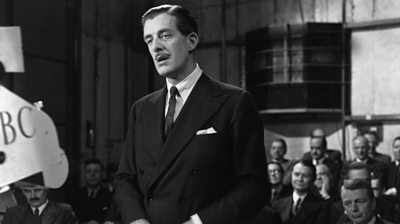
So, as well as the returning Jasmine Bligh and her new announcing colleagues Winifred Shotter and McDonald Hobley, and the assorted invited dignitaries, there was also a special guest as part of the presenting team for the 鈥榳elcome back鈥� programme. This was Leslie Mitchell, another of the pre-war announcers, returning to television here as a one-off.
A Mickey Mouse effort
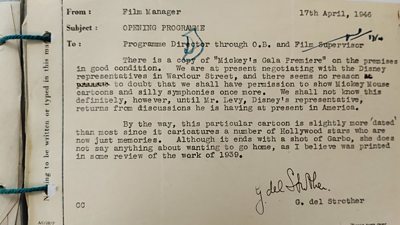
Another link to the past was a repeat of the Disney cartoon short Mickey鈥檚 Gala Premier, which had been the last full programme to be shown on the in September 1939. It had been decided it would be appropriate to pick up the baton with another broadcast of this during the re-opening show, with Programme Director Denis Johnston asking for this to be looked into in April.
The cartoon seems to have replaced an earlier idea present in Johnston鈥檚 first draft outline of the re-opening, where the link to 1939 would have been achieved by showing a section of a 鈥渟hort play from Studio B that was in rehearsal when war broke out, with as far as possible the original cast.鈥�
The 91福利社 had been doing the UK branch of Disney a favour by storing through the war a large number of the company鈥檚 cartoons, which they had broadcast in the 1930s. These were still being looked after by the corporation, and 鈥� although no formal deal with Disney had yet been signed to show them on the revived service 鈥� the animation house was more than happy to agree to Mickey鈥檚 Gala Premier being transmitted on the first day back.
The 91福利社鈥檚 Film Manager, Greeve del Strother, had however warned that 鈥渢his particular cartoon is slightly more 鈥榙ated鈥� than most since it caricatures a number of Hollywood stars who are now just memories.鈥� But, with that sense of wanting to provide continuity with what had come before, just under 40 minutes into television鈥檚 return Mickey鈥檚 Gala Premier was indeed shown again.
As well as the links to the past, though, the 91福利社 was also keen to celebrate progression, with the re-opening programme highlighting one key technical advance which had been made since the 1930s. Pre-war, it had not been possible for the 91福利社 to make instant cuts between live cameras 鈥� only very quick mixes. They now had this capability, which was specifically scripted to be referred to during Maurice Gorham鈥檚 address to the viewers.
A week ahead of the re-opening, Gorham wrote to , to thank him for this advance being achieved. 鈥淚 must congratulate you very warmly on behalf of all my producers for providing us with cuts as well as mixes in time for the opening. As you know, this is a development which we particularly wanted and it will give enormous additional scope in handling productions of all kinds.鈥�
Victory Day
Part of the timing of the return of television had been decided not simply by when the personnel and equipment would be ready again, but to gain publicity with an eye-catching outside broadcast. Such programmes, covering events on the scene as they happened, had been one of the most popular elements of the pre-war service, something of which the 91福利社 was well aware.
There had been some initial idea of possibly re-opening earlier in that first week of June in time to cover the Derby, one of horse-racing鈥檚 crown jewels, on June 5. Then the grand would be broadcast on the Saturday three days later. This was due to see British and Allied military personnel, and civilian organisations which had been part of the war effort, march in celebration through central London.
However, it was clear that doing both of these events would be pushing it, especially as the television service鈥檚 outside broadcast truck was only just back in service with a few days to spare. So it was agreed that all the effort should go into covering the Victory Parade, which would take place on what would now be only television鈥檚 second day back.
鈥淭his is our El Alamein,鈥� TV Outside Broadcasts Manager Ian Orr-Ewing wrote a couple of weeks before the big day, employing a suitably wartime analogy. Orr-Ewing then outlined the pressure the outside broadcast staff were under: 鈥淲e will only have had 5 days in which to train and rehearse the entire engineering and programme staff compared with the 3 months which has been possible in the studios.鈥�
Apart from a brief interval for a few minutes at midday, this mammoth outside broadcast lasted for nearly two-and-a-half hours through late morning and early afternoon on the Saturday 鈥� a hugely ambitious effort.
Programme praise
The Victory Day programme was not without its issues. Coverage of the concluding RAF flypast was described by Television Outside Broadcast and Film Supervisor Philip Dorte, Orr-Ewing鈥檚 boss, as a 鈥渇iasco鈥�, and plans to additionally cover the evening鈥檚 river pageant had to be abandoned after cables laid two days in advance were soaked by rain. Yet the day was quickly hailed as one of triumphs of television鈥檚 short life.
鈥淏efore we tackled this OB I said, you will remember, something to the effect that 鈥榟owever much of a mess we make of it it will get a good hand鈥�,鈥� Dorte wrote to Orr-Ewing the following week. 鈥淭o some extent we did but 鈥� it has.鈥�
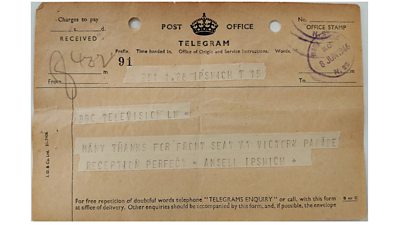
The re-opening programme the previous day had also drawn praise, and its 91福利社 production file contains an envelope filled with congratulatory telegrams and other messages relating to both the first day back and the Victory Parade coverage.
Some are from places such as Ipswich in Suffolk and Minehead in Somerset, reporting good reception of TV鈥檚 return far beyond the official range of the 91福利社鈥檚 sole transmitter mast at Alexandra Palace. Many of these viewers would have been among the 20,000 or so who were reckoned to have bought TVs in the 1930s, and who had carefully looked after their dormant sets for well over six years.
Film fragments
Like so much from the early decades of television, there is very little for a modern viewer to judge these programmes by. But there are some fragments.
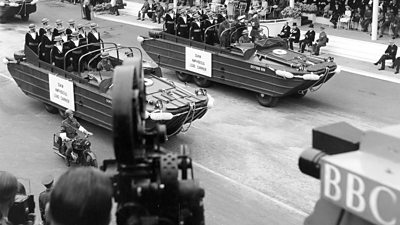
The 91福利社 arranged for a film camera to capture Jasmine Bligh鈥檚 re-opening announcement on the Alexandra Palace terrace, from just behind the television one, and a sound-only recording was also made of about ten minutes鈥� worth of that special programme. For the Victory Parade there was a more substantial effort, in order to be able to show a few minutes of highlights that evening and again the following day.
There was not yet any reliable, professional method of recording a live television picture. But a film camera was placed on one of the outside broadcast positions, and the television commentators were cued-in for when that camera was running. They were then able to tailor their live commentary to also work as a self-contained section for the later film viewers. This was recorded so it could be rapidly edited with the film to provide brief highlights without any additional commentary needing to be written, recorded, and dubbed onto it.
Thus the short 91福利社 film segment which survives provides a snapshot of the parade coverage from a camera right next to two of the live ones and using some of the actual television commentary. The film camera鈥檚 placement, however, had not gone down well with Ian Orr-Ewing, as he wrote in his official report on the broadcast.
鈥淭wo television cameras and the cine camera were squashed into a space 6 feet wide which very considerably handicapped the panning of the television cameras, and this arrangement should never be allowed on future occasions.鈥�
Those interested in the history of the medium, however, can be grateful that this enabled the preservation of a close approximation of part of a major broadcast otherwise completely lost to history.
A star is born
Working on the commentary for the Victory Parade was a man who would, over the next 20 years, go on to be indelibly linked with 91福利社 Television鈥檚 coverage of major national events and state occasions.
Richard Dimbleby was already a well-known 91福利社 journalist, who had been one of the voices of its wartime reportage. He had no need to throw in his lot with the new and still-little-seen medium, but he had clearly decided that television was something he wanted to be a part of.
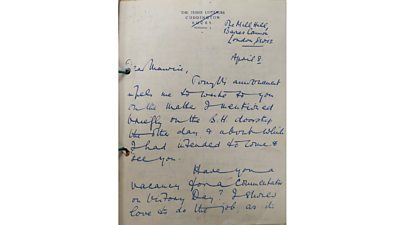
The production file on the preparations for the Victory Parade coverage contains a priceless document, one of many such precious fragments of the country鈥檚 cultural history preserved in the 91福利社 Written Archives at Caversham. It鈥檚 Dimbleby鈥檚 letter to Maurice Gorham of April 8 1946, the day of the announcement that the Victory Parade would be televised, asking if he could be a part of the team.
鈥淗ave you a vacancy for a commentator on Victory Day? I should love to do the job as it鈥檚 something I鈥檝e been greatly interested in for a long time鈥� You鈥檒l know, of course, that I鈥檝e done a good many major commentary jobs for sound OBs, & I think I understand the different technique for your medium鈥� Whether June 8 is an open date or not, I would very much like some television work, & I am sufficiently free to be able to fit things in at short or long notice.鈥�
had already been selected for commentary duties, having been a television commentator before the war on big outside broadcasts such as the 1937 coronation parade.
But the Alexandra Palace bosses jumped at the opportunity to have a figure of Dimbleby鈥檚 reputation alongside him. 鈥淚 think he may be just the man we want as he is a well-known radio commentator who is not attached, and most of the good ones are likely to be locked up on an occasion like the Victory Parade,鈥� was Gorham鈥檚 verdict to his colleagues.
Dimbleby would go on to be one of the best-known 91福利社 Television personalities of the immediate post-war era, right up until his death in 1965. But other elements which would also become regular parts of the television schedule were also starting to form over that re-opening weekend.
A glimpse of the future
Before the war, 91福利社 Television had not had any regular, dedicated children鈥檚 programmes 鈥� only the occasional experiment. But on the afternoon of Sunday June 9, a short space was set aside in the comeback schedules for a brief children鈥檚 sequence. This slot, titled , would now be a regular presence on Sundays and over the next few years would expand until eventually by the end of 1950 there were children鈥檚 shows every day.
On the bill that first Sunday back were Ann Hogarth, Jan Bussell and their Hogarth Puppets act. Later in 1946 it would be they, alongside Annette Mills, who would introduce in For the Children which would be the first fictional character in British television history to become a household name.
Television was back 鈥� and before very long, it would be bigger than ever.
Paul Hayes is a writer and radio producer
Links
-
First-Year Flashbacks 91福利社 iPlayer
-
Radio Times
-
Prospero
-
Connected Histories of the 91福利社
The 91福利社 is not responsible for the contents of any external sites listed