91¸£ÀûÉç

The 91¸£ÀûÉç and World War Two - picture gallery

Images of the 91¸£ÀûÉç as seen on the brink of war in 1939, during the war, and beyond.
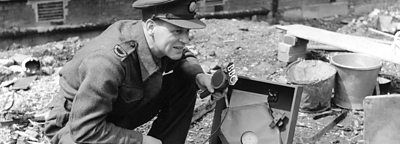
Picture shows C.D Adamson, engineer correspondent of the 91¸£ÀûÉç War Reporting Unit, with a midget Recorder of the type used in Normandy.

91¸£ÀûÉç Bridge Club - men and women play bridge inside the curved 1930s senate room at Broadcasting House
The 91¸£ÀûÉç clubs were legendary pre-war, and a considerable attraction to staff joining the corporation. The 91¸£ÀûÉç Bridge Club, continues un-perturbed by the threat of war, summer 1939.
A man ponders his next chess move while his female opponent looks on
The 91¸£ÀûÉç Chess Club was attractive to the producers of serious music on the 91¸£ÀûÉç 91¸£ÀûÉç Service, and was still in operation by the Autumn of 1939.
A building site behind 91¸£ÀûÉç Broadcasting House
Despite clear indications that war was on the horizon, the new extension to the 91¸£ÀûÉç’s Broadcasting House in London was still under construction by the end of 1939.
The entrance hall of Broadcasting House in 1939, men and women in smart clothes sit around the art deco opulence
Keeping up the facade of normality in Broadcasting House in 1939. Later a sentry was posted outside, and sand bags issued to protect studios within.
King George VI, Queen Elizabeth, Princess Elizabeth and Princess Margaret inspect the work of various radio technicians at Broadcasting House
King George VI, Queen Elizabeth, Princess Elizabeth and Princess Margaret visit Broadcasting House, when war was a mere six months away.
The finishing line of Derby Day, 1939, is filmed by a 91¸£ÀûÉç TV camera
No change to the sports schedule. Derby Day, 1939, considered a 91¸£ÀûÉç TV outside broadcast success.
A racing driver and his pre-war racing car with large radiator is filmed by a TV camera
Motor Racing from Crystal Palace, with war, 4 months away.
Technical experiments in radio continued throughout 1939
Technical experiments in radio continued throughout 1939. Here new kit is being tested in the ‘radio saloon car’.
New radio broadcasting kit is being tested in the ‘radio saloon car’.
Technical experiments in radio continued throughout 1939. Here new kit is being tested in the ‘radio saloon car’.
An engineer fixes a large valve into radio apparatus.
Updating valves at the Clevedon Transmitting Station, June 1939.
Two engineers in suits fiddle with various bits of analogue apparatus in a gothic room
Parts of 91¸£ÀûÉç Research and Development were commandeered for war work, but by February 1939, technical teams were still working solely on 91¸£ÀûÉç projects.
A TV camera filming a male and female inspecting some flowers at the Chelsea flower show
Broadcasting as normal, TV visits the Chelsea flower show in May 1939.
Children gather around a radio set
Children gather round the radio to hear Chamberlain’s declaration of war on Nazi Germany.
Prime Minister Chamberlain at the microphone wearing a stiff collar and tie
Prime Minister Chamberlain, with a solemn message to the nation in 1939.
A 91¸£ÀûÉç Guard soldier with an uncocked shotgun inspects a woman's pass. There are sandbags to their left.
A member of the 91¸£ÀûÉç Guard conducts a security check at the 91¸£ÀûÉç’s Broadcasting House. These were imposed following the declaration of war, and the building is shored-up with sand bags.
Correspondents with 91¸£ÀûÉç Midget Recorders make a report in the field with tin hats on
As war begins, correspondents are sent out with 91¸£ÀûÉç Midget Recorders, and start to send despatches back to London.
Bomb damage inside a sleeping quarter at 91¸£ÀûÉç Maida Vale. There is a hole in the roof and a large amount of rubble.
In 1941 91¸£ÀûÉç buildings were targeted. The Maida Vale studios, home to 91¸£ÀûÉç orchestras, were bombed in May of that year.
Bombed 91¸£ÀûÉç studio with a hole in the ceiling and rubble on the floor
The effect of bombing on 91¸£ÀûÉç studios, 1941.
Jasmine Bligh at a microphone wearing a typical 1940s coat
Pre-war TV announcer Jasmine Bligh whose career was cut short because of hostilities, was the first person to appear on TV in 1946, when 91¸£ÀûÉç TV re-opened.
A large parade with soldiers in full number 1s takes place at Horseguards Parade - a soldier on a podium takes the salute. A 91¸£ÀûÉç TV camera looks on
A moment of tradition - the first full dress parade since 1939, televised by the 91¸£ÀûÉç in 1949.

Search by Tag:

Rebuild Page

The page will automatically reload. You may need to reload again if the build takes longer than expected.

Useful links

Demo mode

Hides preview environment warning banner on preview pages.

Theme toggler

Select a theme and theme mode and click "Load theme" to load in your theme combination.

Theme:
Theme Mode: